War Profits and Insider Trading Risks: How Iran Conflict Moves Oil, Markets and Billion-Dollar Bets
2026-04-21
Positions were taken. Oil futures surged—just ahead of the news. Prediction markets lit up with wagers so precisely timed that regulators are now asking a simple but unsettling question: who knew what, and when?

Recent reporting has revealed that millions—possibly over $1 billion—were placed on geopolitical outcomes tied to the 2026 Iran war, often mere hours or minutes before events unfolded.
In one instance, nearly $950 million was wagered on oil movements shortly before a ceasefire announcement, capturing a near-perfect market swing.
U.S. regulators have since opened inquiries into suspicious oil trades executed just before major policy shifts, trades that generated outsized profits and mirrored classified decision timelines.
The convergence of war, markets, and opaque trading has revived an old suspicion in modern finance: that conflict itself may be one of the most lucrative insider trades of all.
A Market That Moves Before the Missiles
The current Iran conflict—sparked by U.S. and Israeli strikes that killed senior Iranian leadership and triggered a regional escalation—has sent shockwaves through global markets.
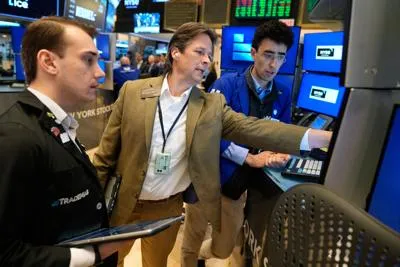
Image: Patrick McKeon, center, works on the floor at the New York Stock Exchange in New York on March 31.
Oil prices spiked, shipping routes froze, and equities whipsawed in response to each headline.
But beneath the volatility lies a more troubling pattern.
- Large bets placed just before U.S. airstrikes
- Oil futures trades executed hours ahead of ceasefire announcements
- Prediction-market wagers tied to leadership changes and military outcomes
Some traders walked away with hundreds of thousands to millions in profits, often with uncanny precision.
Officials in Washington have gone so far as to warn government staff against exploiting confidential information, underscoring fears that sensitive intelligence may be leaking—directly or indirectly—into financial markets.
The Commodity Futures Trading Commission (CFTC) is now examining whether these trades represent coordinated speculation—or illegal insider activity linked to policy decisions.
Prediction Markets: The New Frontier of War Profiteering
Unlike traditional insider trading, today’s activity extends beyond equities and commodities into prediction platforms such as Polymarket and Kalshi, where users can bet on real-world events.
These platforms—once niche—have evolved into multi-billion-dollar ecosystems blending finance, gambling, and geopolitics.
Their appeal is simple:
- No need to own assets
- High leverage on outcomes
- Often anonymous participation
The result is a system where a trader can, in effect, bet directly on war itself.
Critics argue this creates dangerous incentives. If market participants can profit from conflict outcomes—and potentially influence narratives or information flows—the line between observer and participant begins to blur.
History’s Shadow: War and Insider Advantage
While the tools are new, the phenomenon is not.
World War I & II: The Birth of Strategic Trading
During both world wars, governments tightly controlled information flows, yet rumors and privileged access still shaped markets. Industrialists and financiers with proximity to military procurement often secured massive gains through early knowledge of supply contracts and resource shortages.
Vietnam War: Defense Stocks and Political Signals
In the 1960s and 1970s, investors closely tracked Pentagon decisions. Defense contractors saw share price surges aligned with escalation phases, and well-connected insiders occasionally benefited from early signals embedded in policy discussions.
Gulf War (1990–91): Oil and Satellite Intelligence
As coalition forces mobilized against Iraq, oil markets became the primary theater for speculation. Traders with access to shipping data and intelligence assessments were able to front-run supply disruptions, generating substantial profits.
Iraq War (2003): The “War Trade”
Perhaps the most documented modern case, the run-up to the Iraq invasion saw:
- Oil prices climbing on anticipated disruption
- Defense stocks rallying sharply
- Currency markets shifting on geopolitical risk
While not always illegal, analysts widely noted that “the war trade” rewarded those closest to policy signals, including hedge funds with deep political networks.
Arab Spring (2011): Information Arbitrage
During uprisings across the Middle East, traders exploited fragmented information flows, capitalizing on sudden regime changes and commodity shocks—again highlighting how speed of information equals profit.
What Makes 2026 Different
The Iran war may represent a turning point—not because insider trading exists, but because its scale, speed, and accessibility have changed dramatically.
Three structural shifts stand out:
1. Financialization of Geopolitics
War is no longer just a macroeconomic factor—it is now a tradable event class, with instruments designed explicitly to monetize outcomes.
2. Anonymity and Blockchain Infrastructure
Modern platforms allow traders to operate without clear identity trails, complicating enforcement and enabling cross-border activity.
3. Millisecond Information Arbitrage
In an era of algorithmic trading, even minutes of advance knowledge can yield millions, especially in oil and derivatives markets.
The Regulatory Gap
Despite mounting concerns, enforcement remains fragmented.
- The CFTC is investigating—but faces jurisdictional limits and resource constraints
- Prediction markets operate in legal gray zones, straddling finance and gaming
- International coordination is limited, even as trades span multiple exchanges
The result is a system where proof of wrongdoing is difficult—even when patterns appear statistically improbable.
A Market Signal—or Something More?
Not all suspicious trades are illegal. Markets, by design, anticipate events.
But when trades consistently precede geopolitical shocks with near-perfect accuracy, the distinction between informed speculation and illicit knowledge begins to erode.
For now, regulators are left chasing patterns in a system built on speed and opacity.
For investors, the lesson may be more sobering:
in times of war, the biggest gains are often made not on the battlefield—but in the moments just before it begins.
By Tommy Thounaojam

Stay updated with our latest news and articles. Join our newsletter!
Trending Now
No trending posts found.