Guaranteed Returns on Mutual Funds: What Beginners Need to Know
2026-08-10
When you start investing, the most catchy phrase and most likely one you hear is “guaranteed returns.” It sounds reassuring, especially when you have only recently started working and have managed to save up for your first round of mutual funds.
You may then come across mutual funds promising attractive historical returns, government bonds offering fixed interest, bank deposits carrying guaranteed rates, and investment products designed to protect your savings. But there is an important distinction that every beginner needs to understand: Mutual funds do not generally offer guaranteed returns. A mutual fund pools money from investors and uses it to buy a portfolio of assets, such as stocks, bonds, and other securities. If those investments increase in value, the fund can generate a profit. If they decline, the value of your mutual fund investment can fall.
So where does the idea of “guaranteed mutual fund returns” come from? Let’s explore.
How Do Mutual Fund Return Rates Work?
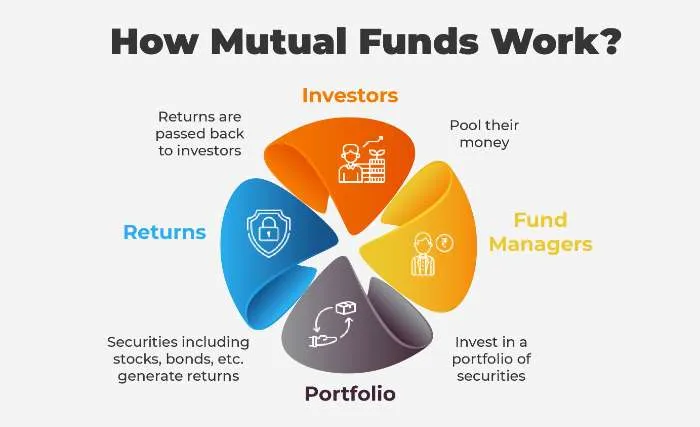
Think of a mutual fund as a large basket where you collect different stuff and pay for it as a whole. So while investing in mutual funds, you buy a fund alongside thousands of other investors.
The fund manager uses the pooled funds to purchase investments according to the fund's objective. For example, an equity mutual fund might invest in:
- Technology companies
- Banks
- Healthcare companies
- Consumer businesses
- Energy companies
- Other publicly traded stocks
If the companies in the fund perform well, the value of the fund can increase. If the market falls, the value can decline.
So the average return on mutual funds comes primarily from changes in the value of the investments held by the fund and, where applicable, income such as dividends or interest.
Example of How Average Return On Mutual Funds Works?
Suppose you invest your initial $1,000 in an equity mutual fund.
- If the fund happens to earn: 10% in Year 1 → $1,100
- But then the market falls: -5% in Year 2 → approximately $1,045
- Then perhaps it rises: 12% in Year 3 → approximately $1,170
- Then another strong year: 8% in Year 4 → approximately $1,263
- And then:-3% in Year 5 → approximately $1,225
This is only an illustration, but it demonstrates the difference.
A mutual fund does not necessarily move upward in a straight line. One year can be excellent. Another year can be negative. The important number for a long-term investor is the overall return across the entire investment period, not whether every individual year was positive.
Are Mutual Fund Returns Guaranteed?

If you have seen the ads or heard their warning, mutual funds are subject to market risks, so no, they are not in the normal sense of a guaranteed investment product. Usually this puzzlement comes from confusing historical returns with guaranteed returns, or from confusing mutual funds with fixed-income products such as certificates of deposit, guaranteed investment certificates, government savings bonds or fixed deposits.
- Understanding this difference can help a first-time investor decide whether the priority should be protecting money, generating predictable income or pursuing long-term growth.
- A mutual fund can provide a potential return, an expected yield or a history of returns, but that is different from a guaranteed return.
- Mutual funds are market-linked investments. Their value can change depending on the securities they hold. For example:
- A stock mutual fund can experience substantial losses during a market downturn. Even a bond mutual fund can lose value because bond prices can change when interest rates move.
- The U.S. Securities and Exchange Commission specifically notes that mutual funds are not guaranteed or insured by the FDIC or another government agency, and investors can lose money.
- A mutual fund can have an impressive historical return without having a guaranteed future return. So, instead of asking: "Which mutual fund guarantees my money?" a better question is: "Which mutual fund gives me the right balance of risk, cost, diversification and potential return for my goal?"
Understanding The Distinction Of Terms Related to Mutual Funds
Term | What it means |
Guaranteed return | The product's terms promise a specified return or repayment, subject to applicable conditions |
Fixed interest rate | The stated interest rate is set for the applicable period. |
Historical return | What an investment earned in the past |
Expected return | An estimate of what an investment might earn |
Market-linked return | The return changes according to market performance. |
Types of Mutual Funds and Their Returns: U.S. vs Canada vs China vs Singapore vs India
Country | Types of Mutual Funds Available | Indicative Long-Term Return Range* | Are Returns Guaranteed? | Lower-Risk Alternatives |
United States ?? |
| ~5–10% for diversified long-term funds, depending on asset mix | No. Mutual funds can gain or lose value and are not FDIC-insured |
|
Canada ?? |
| ~4–9% depending on the fund and market exposure. | No. Mutual-fund returns fluctuate with market performance. |
|
China ?? |
| ~4–10% depending heavily on the fund category and market conditions. | No. Market-linked funds do not guarantee a fixed return. |
|
Singapore ?? |
| ~4–9% depending on asset allocation and market exposure. | No. Unit trusts and mutual funds are market-linked investments. |
|
India ?? |
| ~6–12% over the long term, depending on category and market conditions. | No. Mutual-fund NAVs fluctuate, and returns are not guaranteed. |
|
How To Improve Chances of Returns in Mutual Fund for Beginners?
While you cannot guarantee a mutual fund return, you can make choices that may improve your long-term outcome.
Choose lower-cost funds
- Fees matter because they are deducted from your investment returns.
- Index funds, for example, simply aim to follow an index rather than constantly trying to pick individual winners.
- SEBI notes that passive management generally requires less frequent trading and can reduce management fees.
Diversify
- Instead of putting everything into one sector or company, choose a fund that spreads investments across many securities.
- Diversification doesn't eliminate market risk, but it can reduce the damage that one poorly performing investment can cause.
Invest consistently
- A systematic investment approach can help investors avoid trying to predict the perfect day to enter the market.
- But remember: regular investing does not guarantee profit.
Match the fund to your time horizon.
- If you need your money in six months, an aggressive equity fund may be inappropriate.
- If your goal is 10–20 years away, you may have more ability to tolerate short-term market fluctuations.
Reinvest distributions when appropriate.
- Reinvesting dividends or distributions can allow your investment to compound over time.
- Mutual funds for beginners can be taxing, so try guidance notes on reinvestment and purchase additional shares.
Cross-verify your investment terms and returns.
- Always check the current interest rates, tax rules, deposit-insurance limits, investment regulations, and product terms before investing.
- These can change over time, and "guaranteed" applies only to the specific protection or contractual terms of the product, not to all investments.
What Investments Actually Offer Guaranteed or Contractual Returns?
Country | Alternative | What makes it attractive? | Is the return guaranteed? |
U.S. | Bank CD | Fixed interest for a specified term | Generally fixed, with FDIC protection P.S: Subject to applicable limits |
U.S. Treasury securities | Backed by the U.S. government | Principal/interest backed by the U.S. government If held to maturity, subject to the security's terms. | |
Canada | GIC | Fixed term and stated interest rate | Yes, according to the GIC terms Eligible GICs can receive CDIC protection within applicable limits. |
Government of Canada securities | Government-backed debt | Contractual payments Subject to holding/security terms | |
China | Bank deposit | Interest is agreed under the deposit arrangement | Deposit insurance protects eligible Deposits up to RMB 500,000 per depositor per institution. |
Government bonds | Government debt instrument | Payments depend on the bond's terms | |
Singapore | Fixed deposit | Bank offers a fixed interest rate for the agreed tenure | Generally fixed under the deposit terms Eligible SGD deposits are insured up to S$100,000 per depositor per institution. |
Singapore Savings Bonds | Government-issued, long-term savings instrument | Principal is protected Bonds are backed by the Singapore Government | |
India | Bank FD | Fixed interest for the chosen tenure | Fixed according to the FD terms Subject to bank/product conditions |
Government securities/T-Bills | Sovereign debt | Contractual government payments Subject to security terms | |
Government-backed savings schemes | Designed for conservative/long-term savings | Rates and conditions depend on the specific scheme and government rules |
The word “guaranteed” still needs to be examined carefully. A government bond that can be sold before maturity, for example, can fluctuate in market price. Similarly, a bank deposit's guarantee may be subject to a country's deposit-insurance limits.
If you are a beginner wanting to invest in a mutual fund, use this calculator to evaluate your investments and returns to keep track.
Guaranteed Return vs. Mutual Fund For Beginners: The Real Difference
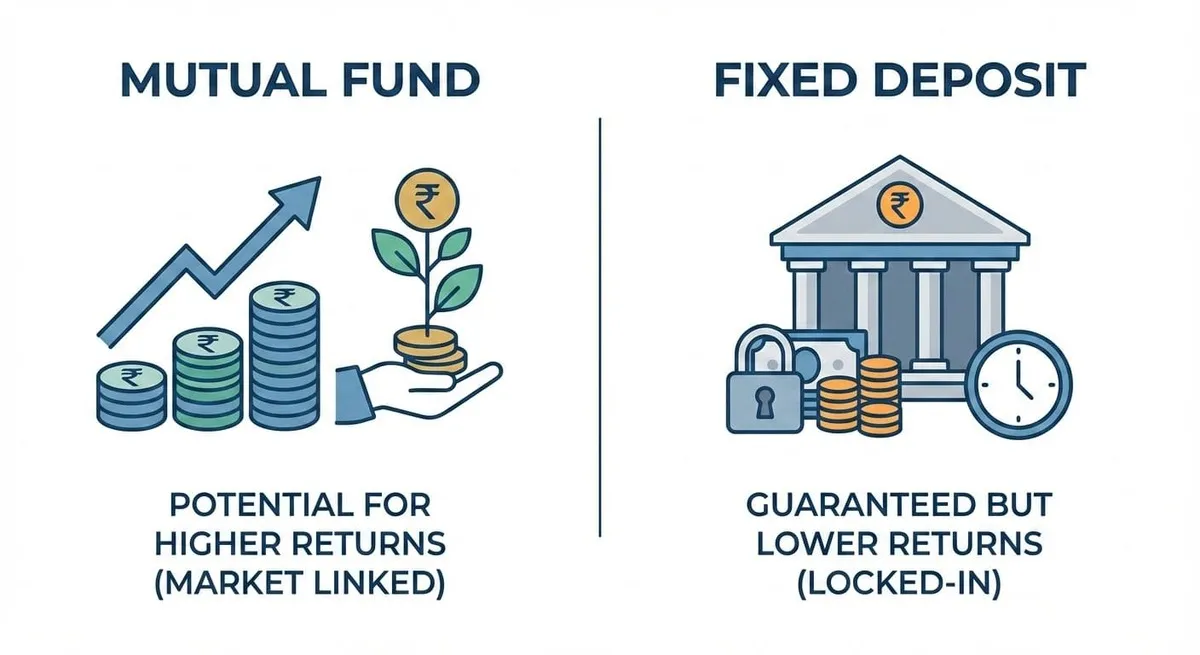
Factor | Mutual Fund | Fixed/Guaranteed-Return Alternative |
Return structure | Market-dependent; returns can vary from year to year | Fixed or contractually determined, depending on the product |
Return certainty | Not guaranteed | May be fixed or contractually defined, depending on the product |
Capital risk | Can rise or fall with the underlying investments | Generally more predictable, subject to the product's terms and protections |
Market exposure | Usually exposed to financial markets | Usually limited or indirect |
Growth potential | Potentially higher over the long term | Generally more limited |
Diversification | Usually diversified across multiple securities or assets | Depends on the product; may be concentrated in one institution or security |
Inflation risk | Potential to outpace inflation over long periods But not guaranteed | Fixed returns may lose purchasing power when inflation is higher than the return |
Liquidity | Depends on the fund and applicable redemption rules | Depends on the product; some have fixed terms or early-withdrawal penalties |
Best suited for | Long-term growth, diversification and investors willing to accept market fluctuations | Capital preservation, predictable income and investors prioritising certainty |
Main concern | Market volatility and potential loss of capital | Lower growth potential, inflation risk and possible lock-in/early withdrawal restrictions |
The Bottom Line: Growth or Guaranteed Returns on Mutual Funds?
To conclude, there are no guaranteed returns in mutual funds. And while investing, beginners need to understand that the real goal should be financial security, not guaranteed returns.
If your priority is certainty, a suitable fixed-income or government-backed instrument may be worth considering. If your priority is long-term growth, diversified mutual funds may have a role, but their returns are never guaranteed simply because they performed well in the past. That's why a sensible portfolio doesn't necessarily have to be mutual funds OR guaranteed investments. It can be both. In this case, a combination of protected savings for security + diversified market investments for growth can be a more practical way to think about your money than searching for a mythical mutual fund that offers high returns with zero risk.
Investing is a big financial commitment; beginners need to research and take a leap of faith to earn their financial security. To know more about mutual funds, financial tools, and updates on business and economic happenings, follow Micromunch.
By P. Manika (Performist Content Writer)

Stay updated with our latest news and articles. Join our newsletter!
Trending Now
No trending posts found.