Trump’s China Visit 2026: Xi Summit, AI Talks, Taiwan Tensions and Top CEOs in Beijing
2026-05-14
US President Donald Trump’s arrival in Beijing has evolved far beyond a traditional diplomatic summit. What initially appeared to be a high-level political engagement with Chinese President Xi Jinping is now emerging as one of the most consequential business-geopolitical gatherings of the decade.
The strongest symbol of that shift is the delegation traveling with Trump: a group of America’s most influential corporate executives spanning technology, finance, energy, manufacturing, retail and artificial intelligence.
The inclusion of figures such as Elon Musk, Tim Cook, Jensen Huang, Satya Nadella and Mark Zuckerberg underscores a major reality: despite years of political confrontation, the United States and China remain deeply economically interconnected.
According to recent reporting from The Wall Street Journal, the summit is increasingly being framed not only around diplomacy and security, but around artificial intelligence, semiconductor dominance, global supply chains, rare-earth minerals, energy security and the future architecture of global commerce.
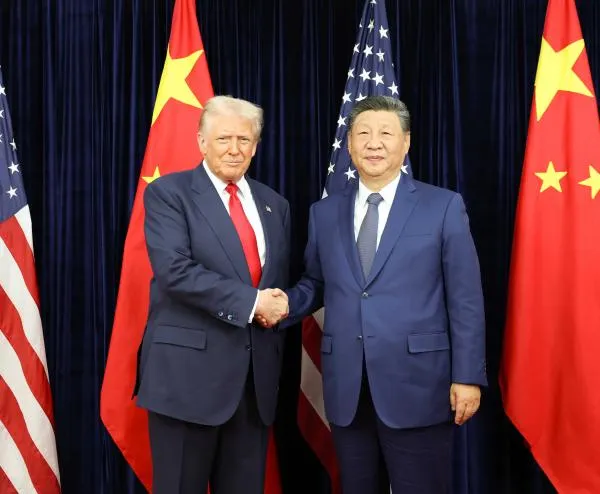
The CEO Delegation: Why It Matters
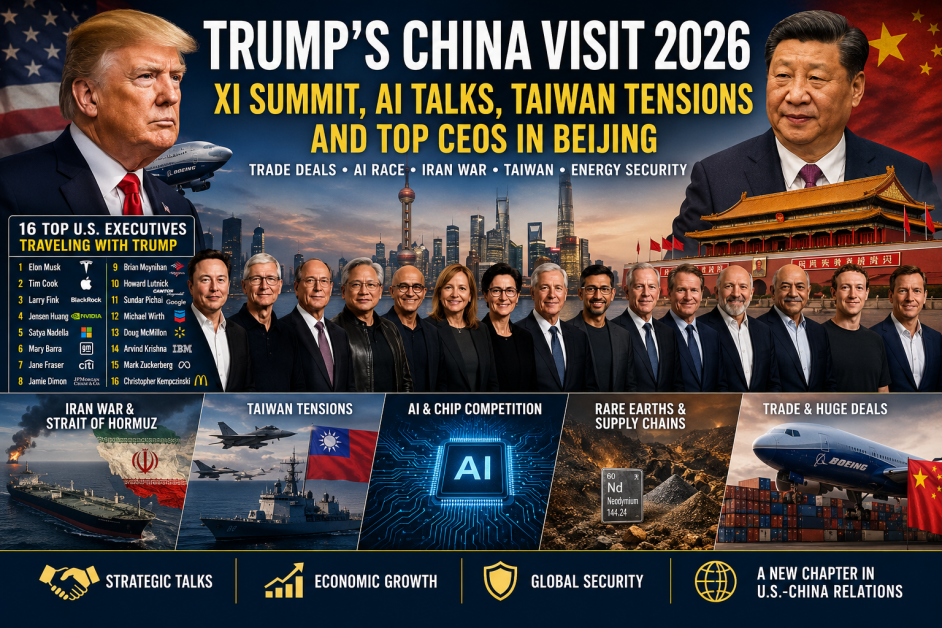
The image circulating globally showing the “16 Top U.S. Executives Traveling with Trump” has become one of the defining visuals of the summit.
The Executives Include:
Technology & AI
- Elon Musk — Tesla
- Tim Cook — Apple
- Jensen Huang — NVIDIA
- Satya Nadella — Microsoft
- Sundar Pichai — Google
- Mark Zuckerberg — Meta
- Arvind Krishna — IBM
Finance & Banking
- Larry Fink
- Jamie Dimon
- Jane Fraser
- Brian Moynihan
Industry, Energy & Consumer
- Mary Barra
- Michael Wirth
- Doug McMillon
- Christopher Kempczinski
This delegation reflects the sectors most vulnerable to a worsening US-China economic split.
Why Trump Brought America’s Tech Titans to Beijing
AI Is Now the Core Battlefield
The summit’s most important long-term issue may not be tariffs or even Taiwan — it is artificial intelligence supremacy.
Key Topics Under Discussion:
- Advanced semiconductor restrictions
- AI infrastructure
- Cloud computing access
- Military AI safeguards
- Quantum computing
- Data governance
- Rare-earth supply chains
The presence of NVIDIA CEO Jensen Huang is especially significant because NVIDIA chips remain central to the global AI boom.
China has aggressively tried to reduce dependence on American chips after Washington expanded export restrictions on advanced semiconductors. Beijing sees access to AI hardware as essential for economic and military competitiveness.
Meanwhile, US firms fear losing access to the world’s second-largest technology market.
Elon Musk’s Role Could Be Bigger Than Anyone Expected
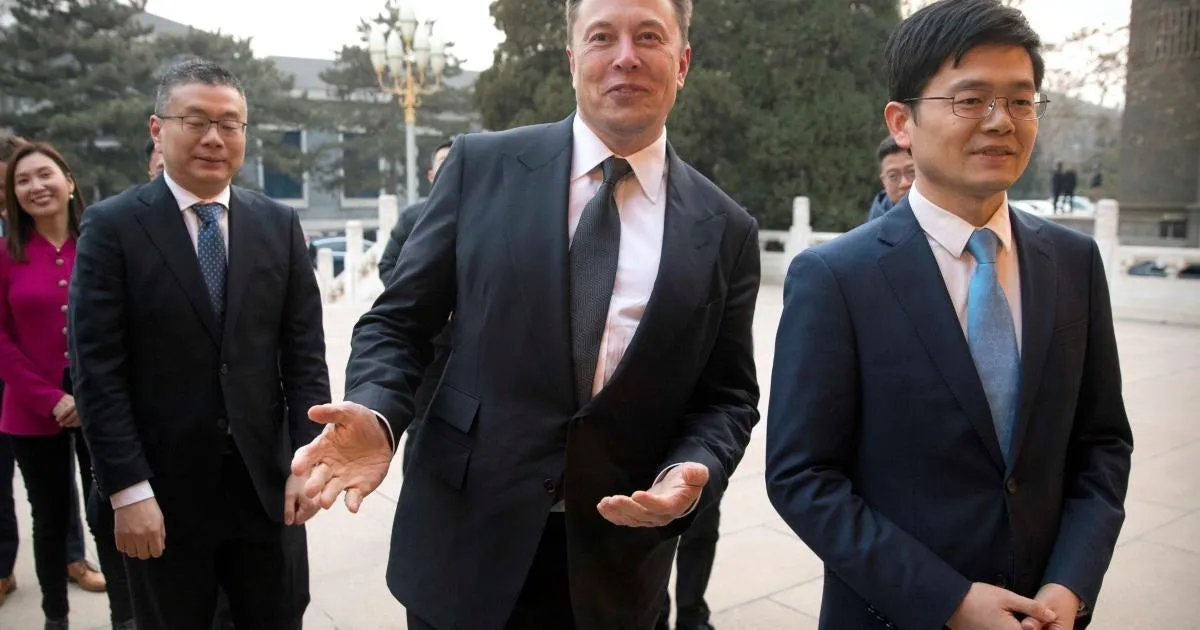
Among all executives attending, Elon Musk may be the most strategically important.
Tesla’s Shanghai Gigafactory remains one of the company’s largest production centers globally, and China represents a critical EV market for Tesla revenue growth.
Why Musk Matters in the Summit
- China controls much of the EV battery supply chain
- Tesla depends heavily on Chinese manufacturing
- Beijing sees Musk as more pragmatic than many US political leaders
- SpaceX and Starlink add national-security dimensions
Chinese officials reportedly view Musk as a bridge between Silicon Valley and Beijing, especially as US-China technological rivalry intensifies.
However, Musk also faces pressure from Washington over concerns involving:
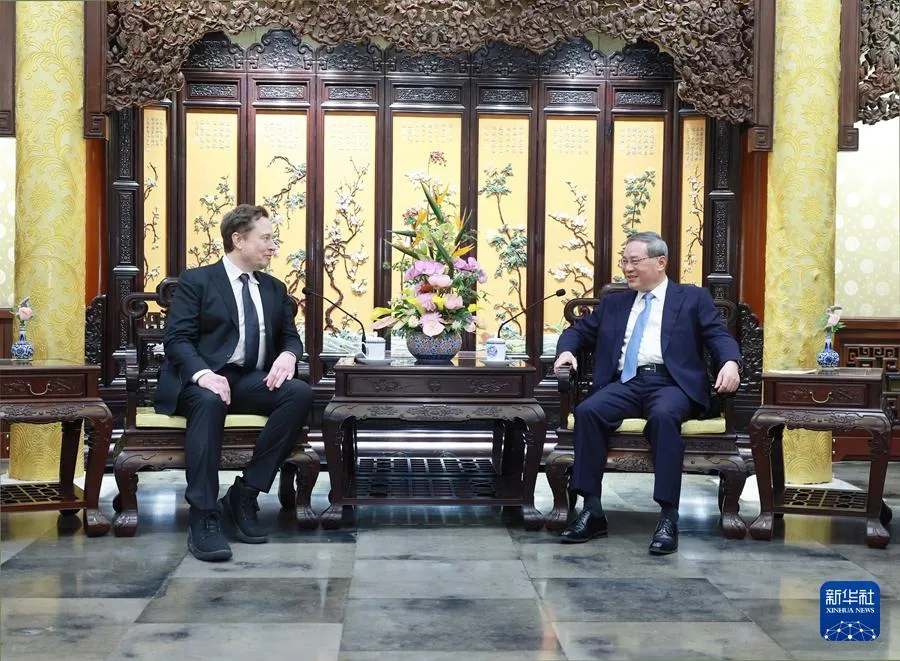
- AI security
- Data localization
- Autonomous driving technology
- Semiconductor sourcing
This places him at the intersection of commerce and geopolitics.
Apple and Tim Cook Face a Critical China Reality
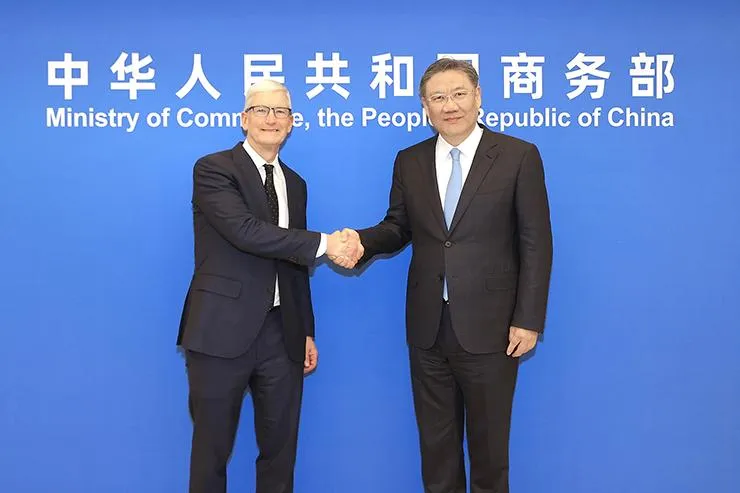
Apple CEO Tim Cook’s participation highlights the enduring complexity of US-China economic dependence.
Despite diversification efforts into India and Vietnam, Apple still relies heavily on China for:
- iPhone assembly
- Electronics manufacturing
- Supplier ecosystems
- Consumer sales
The summit comes as Apple faces growing Chinese competition from domestic brands and increasing political scrutiny in both Washington and Beijing.
What Apple Wants
- Stable trade conditions
- Predictable regulation
- Supply-chain continuity
- Semiconductor cooperation
What China Wants
- Continued foreign investment
- Advanced manufacturing partnerships
- Reduced US export restrictions
- AI collaboration
Cook’s presence signals that complete economic decoupling between the US and China remains unrealistic in the near term.
Iran War Changes the Entire Strategic Equation
While economics dominates headlines, the Iran conflict remains the summit’s biggest geopolitical shadow.
China Holds Rare Leverage Over Tehran
China is:
- Iran’s largest oil customer
- A major diplomatic partner
- One of the few powers with meaningful leverage over Tehran
Washington reportedly hopes Beijing can help stabilize the Strait of Hormuz crisis and prevent wider energy-market disruption.
The war has:
- Increased oil-price volatility
- Intensified global inflation fears
- Pressured supply chains
- Elevated China’s diplomatic influence
Xi Jinping has carefully positioned China as:
- Critical of unilateral sanctions
- Opposed to escalation
- Open to mediation
- Strategically neutral
This balancing act has strengthened Beijing’s global diplomatic standing.
Taiwan Remains the Most Dangerous Flashpoint
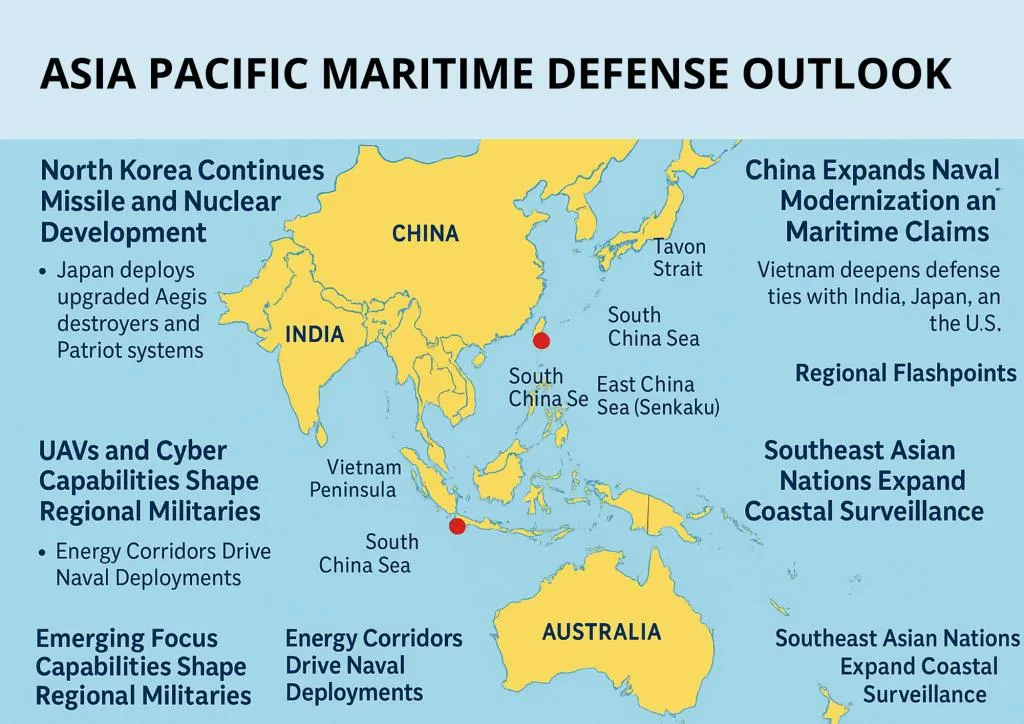
Despite the economic focus, Taiwan remains the summit’s most sensitive issue.
Trump’s suggestion that he may discuss US arms sales to Taiwan directly with Xi Jinping has triggered concern among analysts and officials in Taipei.
Historically, Washington has maintained strategic ambiguity regarding Taiwan while avoiding signals that Beijing could shape US defense commitments.
China’s Objectives
- Reduce US military support for Taiwan
- Limit advanced weapons transfers
- Push Washington toward strategic concessions
America’s Objectives
- Maintain Indo-Pacific deterrence
- Protect semiconductor supply chains
- Reassure allies including Japan and South Korea
Any perceived softening on Taiwan could dramatically reshape regional security dynamics.
Trade Deals and Boeing Mega Agreement Back in Focus
Economic announcements are expected to dominate the summit’s public messaging.
Boeing Could Secure Historic Aircraft Deal
Reports indicate China may approve a purchase of roughly 500 Boeing aircraft — potentially one of the largest commercial aviation deals in history.
The agreement would:
- Support American manufacturing jobs
- Boost Boeing after years of turbulence
- Symbolize temporary stabilization in US-China ties
Additional agreements could involve:
- Agricultural exports
- Energy purchases
- Financial-market access
- AI cooperation frameworks
Trump is likely seeking headline economic victories to offset criticism surrounding the prolonged Iran conflict.
What This Summit Really Reveals
The biggest takeaway from the Beijing summit is that the world has entered a new era where geopolitics and corporate power are deeply intertwined.
The executives traveling with Trump are not merely business leaders anymore. They now represent strategic national assets tied to:
- Artificial intelligence
- Semiconductor dominance
- Energy security
- Supply-chain resilience
- Financial stability
- Technological sovereignty
China understands this clearly.
So does Washington.
Conclusion
Trump’s Beijing visit is no longer just a diplomatic summit — it has evolved into a defining test of how the United States and China will manage competition in the AI age.
The presence of America’s most powerful CEOs reveals the real stakes: global technology leadership, supply-chain control, energy security and economic survival in an increasingly fragmented world order.
While headlines may focus on trade deals and summit optics, the deeper story is about the future structure of global power.
China is leveraging its manufacturing dominance, energy relationships and AI ambitions to strengthen its geopolitical influence. The United States, meanwhile, is attempting to preserve technological leadership while avoiding economic rupture.
The summit also exposes a central contradiction of modern geopolitics: Washington and Beijing increasingly view each other as strategic rivals, yet neither can fully disengage from the other economically.
That reality explains why the world’s most influential business leaders are sitting alongside politicians at the negotiating table in Beijing.
The outcome of these talks could shape not only US-China relations, but the global economy, AI competition and Indo-Pacific security for years to come.
By Tommy Thounaojam

Stay updated with our latest news and articles. Join our newsletter!
Trending Now
No trending posts found.